SHOW-ROOM 2015
Lorraine Châteaux
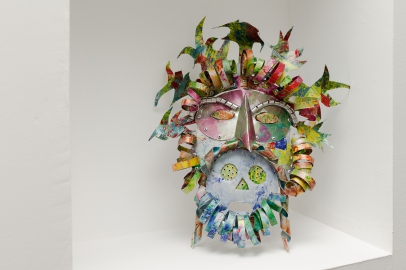
Lorraine Châteaux
Samsung, 2014
aluminium and lazer print on transparent adhesive paper
Courtesy Lorraine Châteaux
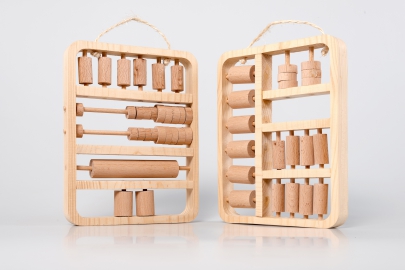
Lorraine Châteaux
Abacus, 2012
wood
Courtesy Lorraine Châteaux
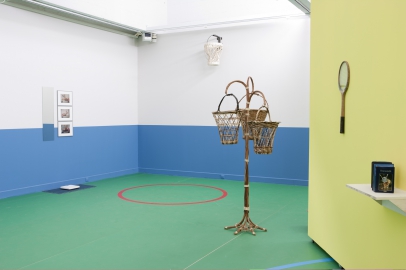
Lorraine Châteaux
Exhibition view "Des corps compétents"
(November 2013 — January 2014)
Courtesy Lorraine Châteaux
For twenty years, the artist Lorraine Châteaux (Paris, 1986) lived in the star-shaped social housing complex in Ivry-sur-Seine (Paris), designed in the 1970s by architects Jean Renaudie and Renée Gailhoustet. She attributes her sensibility for rethinking relationships with the objects around her to that experience, in which it was impossible to adapt the furniture to the interiors.
That unsuitability of forms led to the artist developing an anthropological passion for objects, which translates into an unrestrained, purposeless search for contemporary objects as well as those inherited from modernism. Sculptures such as the abacus (Abacus, 2012), the basketball hoop (Sans titre, 2012), the table football (Pain complet, 2010-2012), the ceramic phone covers (Cowri, 2013) or the Sottsass-style bookcase (Rotolo di Primavera, 2014) are works in which the artist alters their functional status or their fabrication, whether manual or industrial, making use of the forms’ vitality and the manufacturing dynamics they are capable of triggering. Sometimes artefacts, other times readymade or unreadymade* (mass-produced goods), the artist proceeds to overturn the categories of belonging, meaning or usage of her objectsculptures, with a hint of uselessness and amusement thanks to the strangely familiar shapes they retain.
When she uses installations, in which she choreographically assembles a series of autonomous sculptures, such as Le Cloud (2014) or Schèlvre (2013), the artist prefers to focus on the ostentation of the elements presented, playing with the device of the display and of mass media language. In La salle des montres (2015) – meaning “showroom” in Quebecois French – the artist reiterates the very language of the trade fair showroom; she uses the marketing strategies and the serial or handcrafted manufacture of the gadget-objects used for promotional purposes, such as stickers and caps, or even those for Chinese rituals for the cult of ancestor worship, found in flea markets, with boxes
containing kits of extremely cheap everyday items (watches, shirts, phones, costume jewellery) as indispensable items for accompanying
the dead to the next life, on a par with primitive totems. Châteaux multiplies objects and takes into the account the space as a whole:
walls, pedestals, dioramas, industrial goods, artefacts, fakes: she
creates a sort of three-dimensional photocall in which the human
figure is absent, and the objects or "things", as the products of
social agglomerates, are the true protagonists, those which are
entrusted with social relationships. What this artist shows is their
"coolture", their ability to communicate, their symbolic projection into the media universe and their dimension in the globalized world. A dimension in which art today is inexorably absorbed and involved, a source and product for consumption, no different to all the others.
*Joshua Simon, Neomaterialism, Sternberg Press, Berlin, 2013, pp.193