SHOW-ROOM 2015
Elsa Philippe
Elsa Philippe
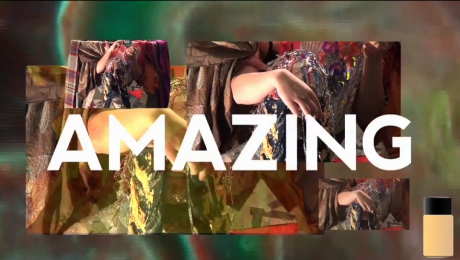
The .&co, 2012
video
10'30"
variable dimensions
Courtesy Elsa Philippe
Elsa Philippe
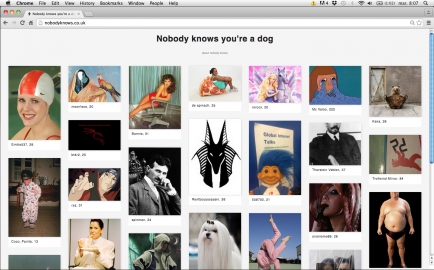
Nobody knows you are a dog, 2014
screen shot of the online database
Courtesy Elsa Philippe
Elsa Philippe
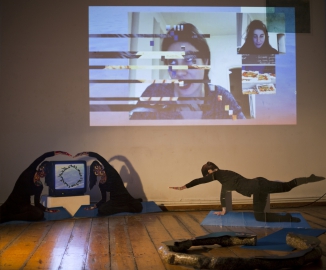
EGOTRIP, 2013-2014
Yoga mat, cardboard, papier-mâché, wood, tv,
video screening, DVD player, 4 books
variable dimensions
Courtesy Elsa Philippe
"On the Internet, nobody knows you’re a dog"* is the phrase, included in one of Peter Steiner’s sketches for the New Yorker in 1993, which marked the beginning of the frequent use of the Internet as subject matter in general interest magazines. The sketch conjured up themes such as privacy and anonymity on the Internet, themes which are also central to the research of Elsa Philippe (Paris, 1987). In Nobody knows you’re a dog (2014), the artist appropriates part of Peter Steiner’s phrase as the title of her online database project, in which visitors to various internet cafés in London can post their own identity for infinity through
images found on the web. The project not only reflects the symbolism of the sketch, but at the same time it highlights the extreme ease with which users can supply their personal information, and with which new technologies are able to store that information. A self-proclaimed child of the generation that grew up under technological progress and the growing cult of the self, the artist is therefore interested in the ways in which the new media slice up and transform our behaviour, and how we negotiate with our own subjectivity. The video The . & co (2012) displays a grotesque, chaotic style that recalls that of the American artist Ryan Trecartin. It explores the ritual of the daily construction of the virtual self, catapulting us into a near future in which people communicate only through new technologies, and the only being who is "different" and excluded from this type of communication is the human being as we know it today.
The question of online behaviour is central to the video-installation And thank god for the catfish (2015), which investigates catfishing, in other words conducting online romantic relationships under a false identity. The installation is conceived like a playground with hyper-realistic landscapes, thanks to the heavy use of ‘trompe l’oeil’. It"incorporates" the spectator into the world of games as a metaphor for this kind of behaviour. In the video, which appears as a continuation of the stage set, the artist brings together various characters who are the product of
the popular technology she has around her: YouTube is her main "DIY shop", and from it she takes films, documentaries, reality shows and
dialogues which she cuts and pastes together to create a universe in which various identities are present, such as a TV newsreader or a policeman; we then discover that only one of them is the real one. The film turns our attention back to the theme of identity, which is as relevant as ever: the multiplicity of identities (in society and in the individual alike) and the prospect of conveying them and making them intelligible to others.