SHOW-ROOM 2014
Samuel Trenquier
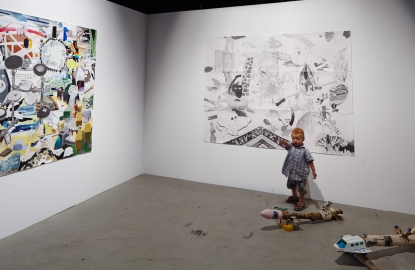
Samuel Trenquier
Le petit Bam-Bam, 2013
gouache, pencil
192 x 150 cm
Installation view ART-O-RAMA 2014
Courtesy of the artist
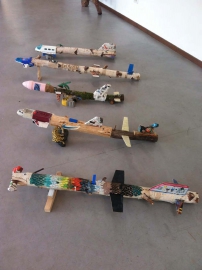
Samuel Trenquier
Missiles, 2013
wood, papier mâché, several objetcs, cardboard, gouache
variable dimensions
Courtesy of the artist
In the dense and at first sight thick jungle that inhabits his graphic and sculptural developments, Samuel Trenquier never gets overwhelmed with surfeit. The visible confusion eventually reveals itself as a trick to the viewer’s eyes, as his assemblages prove to be mastered and profiled: the accuracy of his compositions on the first hand, and the line’s precision on the other hand, but also games of lines and materials within dynamic stings that does not rely on written narrative—everyone invents their own!—but rather on the constant flow able to captivate the eyes and spirit’s motion once inside that autonomous world. Between sculpture and drawing, alike a ping-pong play, they meet each other in subtle assemblages of underlying forms and meanings that are always based on a distant culture, a forgotten custom, a travel to the end of the world… With the continuing concern to symbolically deal with the living, without parting with a kind of exotism which the artist refers to as “a sharp and immediate perception of an everlasting incomprehensibility”, and almost touching the magic.
Furthermore, his work seems to summon the offering. Not the one that deals with ritual but rather with a generosity of giving to anyone that enters in his artwork and ends up overcame with an object or a detail that lives in this unusual environment. During a trip in South America in 2008, the artist got rid of found objects in Checkpoints, arranged in small installations and left there. In the mystery surrounding the artist’s work, there is also the one of the desappearance through some installations that are not always transportable or conceived to be reinstalled elsewhere and which has to be accepted—not for their the ephemeral nature, for their stakes are elsewhere—but rather for a fragility that sets another kind of attention.
In the series Cargo’s cult (2013-2014), with trifled wood missiles on which are added small objects, the artist looks at the mimicry deployed by the aboriginal of Melanesia during the second world conflict, whom—without knowing anything of the new technologies—conceived a replica in the hope it would engender identical consequences of those made by the American and Japanese engines, in particular in terms of resupplying: or when naïve faith almost touches a sort of cannibalism of the image.