SHOW-ROOM 2013
Jérémie Setton
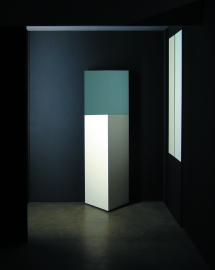
Jérémie Setton
Square (Série des Modules Bifaces), 2012
Acrylic paintings canvas on châssis, 2x58W neon, blackout fabrics, melamine panel
Module 192 X 63 X 46 cm
Space 250 X 200 X 400 cm
Courtesy of the artist
The work of Jérémie Setton performs in a dialectic and epiphanic manner, by immersing us in the relative and temporal experience of perception.
In his modules or installations, for which the viewer is allowed to choose the appropriate aesthetic epithet (as they are modules that are just as pictorially sculptural as they are performative), he enjoys overturning the usual paradigms of pictorial tradition, whether abstract or figurative.
There where for centuries, Western art has attempted to create and summon the illusion of three-dimensional mimetic or the construction of an abstract pictorial spatiality onto a flat surface, Setton seems to pursue a diametrically opposed objective. With him painting comes out of the flat surface, of the frame even, it is applied to a three-dimensional object whose plasticity it specifically aims to destroy in order to make it appear flat and two-dimensional.
Another way to introduce his approach would be to emphasise the use of recognition, a comparison of values and contrasts, chromatic and luminous, there where once again our aesthetic tradition of representation would at first sight seek to arouse them.
Setton unifies, patiently and with rigorous empirical, almost scientific, discipline. According to specific situations and cases, he unifies contrasting light through his use of colour, or thwarts colours through his use of light resolves the oppositions of distinct chromatic shades through the simple graduation of white lights.
For this, the abolition of shadows, the first vectors of the materialization of time in space, is also a suspension of temporality within the field of aesthetics.
Yet if this work seems to set its sights on the absolute nature of timelessness, in the same manner as a purified form of time and space, equilibrium is fragile. Setton knows this and plays with it. As, in reality, it is quite precisely the unstable nature of this equilibrium that fascinates him. Thus, the manifestation that confuses the spectator when before his work resides just there, in rupture of this equilibrium, the revelation of the illusion, the artifice achieved, quite simply just by repositioning the viewer.
It is here that his modules, his installations his pictorial objects in effect reveal themselves as inclusive spaces : They absorb and integrate the presence of the spectator, who then find themselves activated by the latter. In this regard, the pictorial field, with Setton, is expansive, relative and also in some way performative.
The gesture, the labour, the mastery of the artist is only revealed when the work changes dramatically due to the disturbance created by the presence of the spectator. Leaning towards invisibility, its erasure, his art imposes itself and is revealed at the very moment that it seems to dissemble itself.
It is thus that Square, the two-sided module which is at the very heart of the presentation set up for the Show Room, is both the image of a plane and the image of a monochrome, and is yet neither one nor the other.
In effect, what we see at first, a blue-grey square in a flat form, resting on a white base, is the result of the perceptual amalgam between the two sides of a two-sided volume, painted in quite contrasting shades. The exact value of these contrasts is determined by the white lateral lighting, adjusted and controlled from the very beginning by reflectors. The shades applied to the side in the shadow and the side exposed to the light have been made and applied in an empirical manner to obtain the complete resolution of the contrasts and volumes. The title of the installation, if it represents an indirect homage to one of the most emblematic works of abstract art, also refers to the usual usage of the term with regards to a space for circulation. Because it is in effect the movement of the spectator around the pictorial-sculptural object that reveals its true meaning.
By prolonging this game onto a geometrical module, Setton also presents a pictorial object that is seen at first as an almost round and transparent object, painted soft grey. Embedded in a box, here the object does not incite movement. On approaching it, one can nevertheless perceive the more contrasted contours and volumes that resemble a skull completely covered with fine short strokes of colour. Thus, as the title and the sub-title of the work does not indicate Dessin – Point Aveugle (Drawing – Blind spot) the object really is a skull (the archetypal form, if one exists, of our pictorial tradition, symbol of vanity, etc.) but completely covered up by a drawing that takes up and annihilates the play on shadow and light upon the object. Here we can understand that contrary to an attempt to make a pictorial reconstitution of the missing objects, the application of paint (or rather, as is the case here, through drawing) results in Setton's work with a sort of “rendering absent” the real object. The title of the artwork refers to the liminal ambiguity of the object in terms of aesthetic status (between a sculpture and a drawing), whereas the sub-title refers to the blindness (both relative and created) of the spectator, as well as to the disappearance of the perception of the very eye-sockets of the skull.
From one to the other, we become aware that Setton is hunting that very precarious moment when the depth of reality becomes the plane and image of our soul. In the creative process and the images that he produces and uses, it is the very absence of the latter that is evoked, just as the subtracting effect of disappearance is paradoxically obtained by the addition of material.
Text by Emmanuel Lambion
Translation by Caroline Newman